Generator Wattage Chart: Running & Starting Watts for US Home Appliances
By PickMyWatt Editorial Team · Methodology & sources
Buying a generator without a wattage chart is guessing. The yellow EnergyGuide label tells you what an appliance uses, but a generator has to cover the starting surge when a motor kicks on — often two to four times the running watts.
This chart is built for US homes. Figures follow manufacturer ranges published for American appliances — for example, Champion Power Equipment lists a typical refrigerator at 150–400 W running / 800–1,200 W starting, and Honda Power Equipment’s US calculator notes that “all wattages are estimates” and that exact draw depends on your application. Use the tables to build your load list, then run the exact numbers in the free generator wattage calculator.
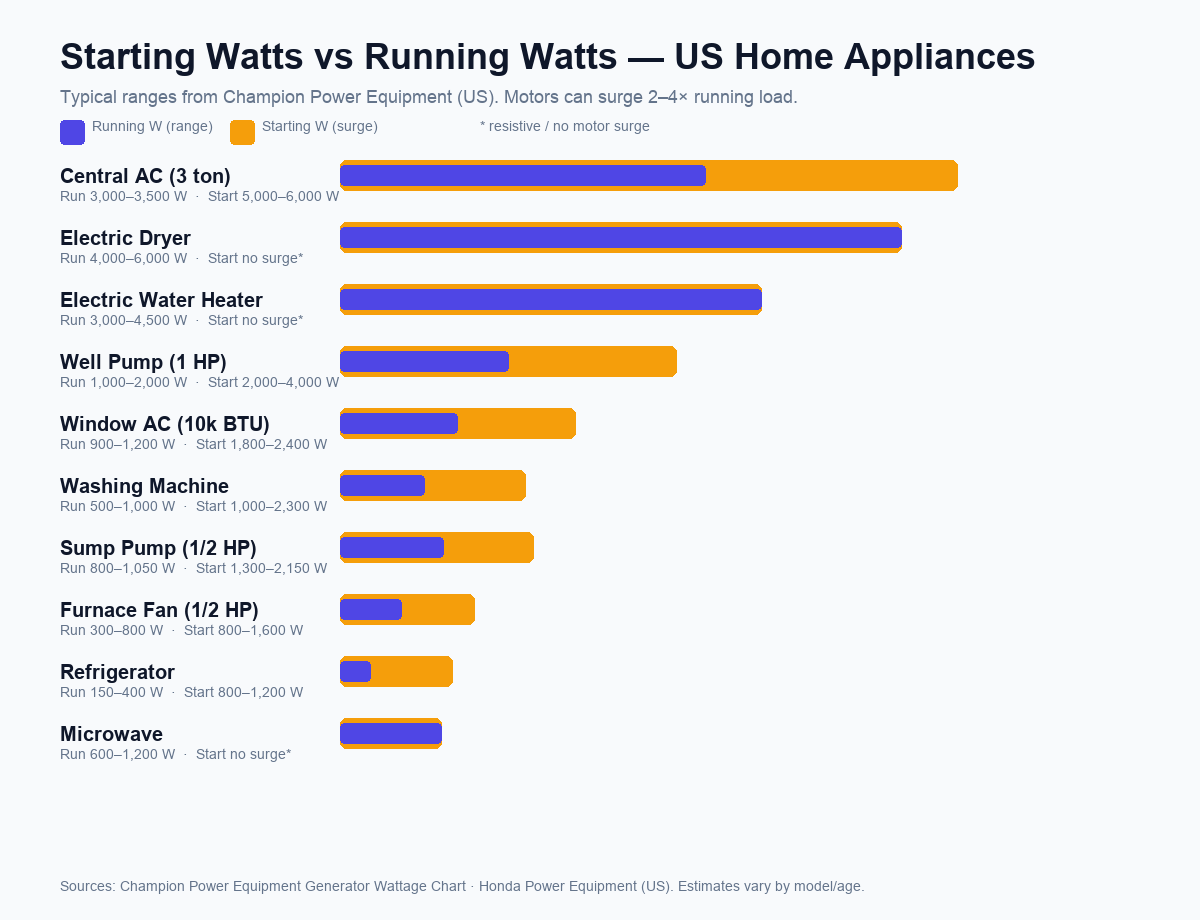
How to read this chart
| Term | What it means | Why it matters |
|---|---|---|
| Running watts (rated / continuous) | Power while the appliance is already on | Adds up while everything runs together |
| Starting watts (surge / peak) | Extra burst for motor startup (1–3 seconds) | Largest starting watt in the house often sizes the generator |
| No surge* | Resistive loads (heaters, incandescent, some dryers) | Size on running watts only |
Rule of thumb: find the biggest motor on your list (AC, well pump, sump pump, fridge compressor). Size the generator for that starting watt + the running watts of everything else you want at the same time. Then apply the NEC 80% rule for continuous loads (run 3+ hours) under NEC 210.20(A) — more on that in our how to calculate generator wattage guide. The National Electrical Code (NFPA 70) is the reference electricians use for continuous vs non-continuous load treatment.
Ranges below are typical for US models. Older or oversized units can be higher. Always confirm on the nameplate (metal tag) or the owner's manual.
Home backup essentials
These are the loads most American households try to keep on during an outage.
| Appliance | Running watts | Starting watts | Notes |
|---|---|---|---|
| Refrigerator | 150–400 W | 800–1,200 W | Compressor surge is the real test |
| Freezer (upright or chest) | 100–500 W | 500–1,000 W | Similar surge pattern to a fridge |
| Window AC (5,000 BTU) | 450–600 W | 900–1,200 W | Common bedroom unit |
| Window AC (10,000 BTU) | 900–1,200 W | 1,800–2,400 W | Living-room / large room |
| Central AC (2 ton) | 2,000–2,500 W | 3,500–4,500 W | Needs a large portable or standby |
| Central AC (3 ton) | 3,000–3,500 W | 5,000–6,000 W | Typical mid-size US home |
| Central AC (4 ton) | 4,000–5,000 W | 6,500–8,000 W | Large home / hot climate |
| Electric water heater | 3,000–4,500 W | —* | Huge continuous load |
| Gas furnace fan (1/2 HP) | 300–800 W | 800–1,600 W | Heat without gas = still need the blower |
| Sump pump (1/3 HP) | 500–800 W | 1,000–1,600 W | Critical in flood-prone basements |
| Sump pump (1/2 HP) | 800–1,050 W | 1,300–2,150 W | More common US size |
| Well pump (1/2 HP) | 750–1,000 W | 1,500–2,000 W | Rural homes |
| Well pump (1 HP) | 1,000–2,000 W | 2,000–4,000 W | Deep wells |
* Resistive or non-motor loads often do not require extra starting watts — size on running watts only.
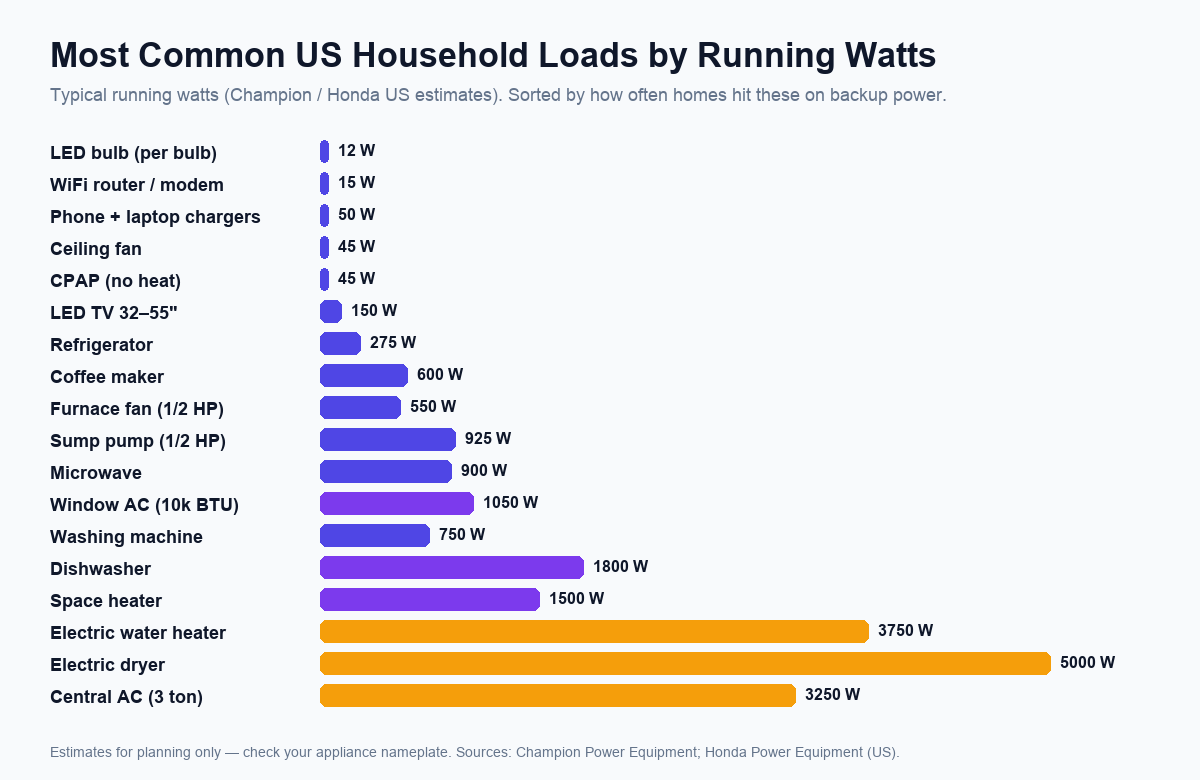
Kitchen & laundry (US models)
| Appliance | Running watts | Starting watts | Notes |
|---|---|---|---|
| Microwave | 600–1,200 W | —* | Oven wattage is usually on the door |
| Dishwasher | 1,200–2,400 W | —* | Heater + motor; heat-dry uses more |
| Electric range (one 8" burner) | 1,200–2,400 W | —* | Oven + multiple burners stack fast |
| Coffee maker | 600–800 W | —* | Drip vs Keurig differ |
| Toaster / toaster oven | 850–1,500 W | —* | |
| Air fryer / Instant Pot | 1,000–1,700 W | —* | Popular post-storm cooking loads |
| Refrigerator (see above) | 150–400 W | 800–1,200 W | |
| Washing machine | 500–1,000 W | 1,000–2,300 W | Agitator + motor surge |
| Electric dryer | 4,000–6,000 W | —* | Often the single largest household load |
| Gas dryer (blower + igniter) | 200–400 W | —* | Much easier on a generator |
Electronics & comfort (low wattage, high priority)
| Appliance | Running watts | Starting watts |
|---|---|---|
| LED bulb (per bulb) | 8–15 W | —* |
| LED TV (32"–55") | 80–400 W | —* |
| Wi‑Fi router / modem | 10–20 W | —* |
| Laptop / phone chargers | 20–100 W | —* |
| Desktop computer | 150–300 W | —* |
| Ceiling fan | 15–75 W | —* |
| Box / window fan | 50–200 W | —* |
| Space heater | 750–1,500 W | —* |
| Home security system | 15–40 W | —* |
| CPAP (no heated humidifier) | 30–60 W | —* |
| CPAP (with heated humidifier) | 60–120 W | —* |
| Oxygen concentrator | 300–600 W | Check nameplate |
Medical devices are non-negotiable on backup power. Size them with headroom and consider an inverter generator for clean power (low THD).
Job-site tools (if you also run a shop)
| Tool | Running watts | Starting watts |
|---|---|---|
| Circular saw (7-1/4") | 1,200–1,800 W | 2,400–3,600 W |
| Table saw (10") | 1,800–3,000 W | 3,600–6,000 W |
| Miter saw (10") | 1,200–1,800 W | 2,400–3,600 W |
| Reciprocating saw | 960–1,200 W | 1,920–2,400 W |
| Angle grinder (4-1/2") | 900–1,800 W | 1,800–3,600 W |
| Electric drill (1/2") | 400–600 W | 800–1,200 W |
| Air compressor (1 HP) | 1,500 W | 4,500 W |
| Air compressor (2 HP) | 2,500 W | 7,500 W |
| Pressure washer (1,500 PSI) | 1,200–1,500 W | 2,400–3,000 W |
| Welder (120 V) | 1,800–2,500 W | 3,600–5,000 W |
RV & camping
| Item | Running watts | Starting watts |
|---|---|---|
| RV AC (13,500 BTU) | 1,500–2,000 W | 2,800–3,500 W |
| RV AC (15,000 BTU) | 2,000–2,500 W | 3,500–4,500 W |
| RV refrigerator | 150–600 W | 400–1,000 W |
| Mini fridge / cooler | 50–100 W | 400–600 W |
| RV microwave | 600–1,200 W | —* |
| Electric grill | ~1,650 W | —* |
| Portable fan | 40–50 W | —* |
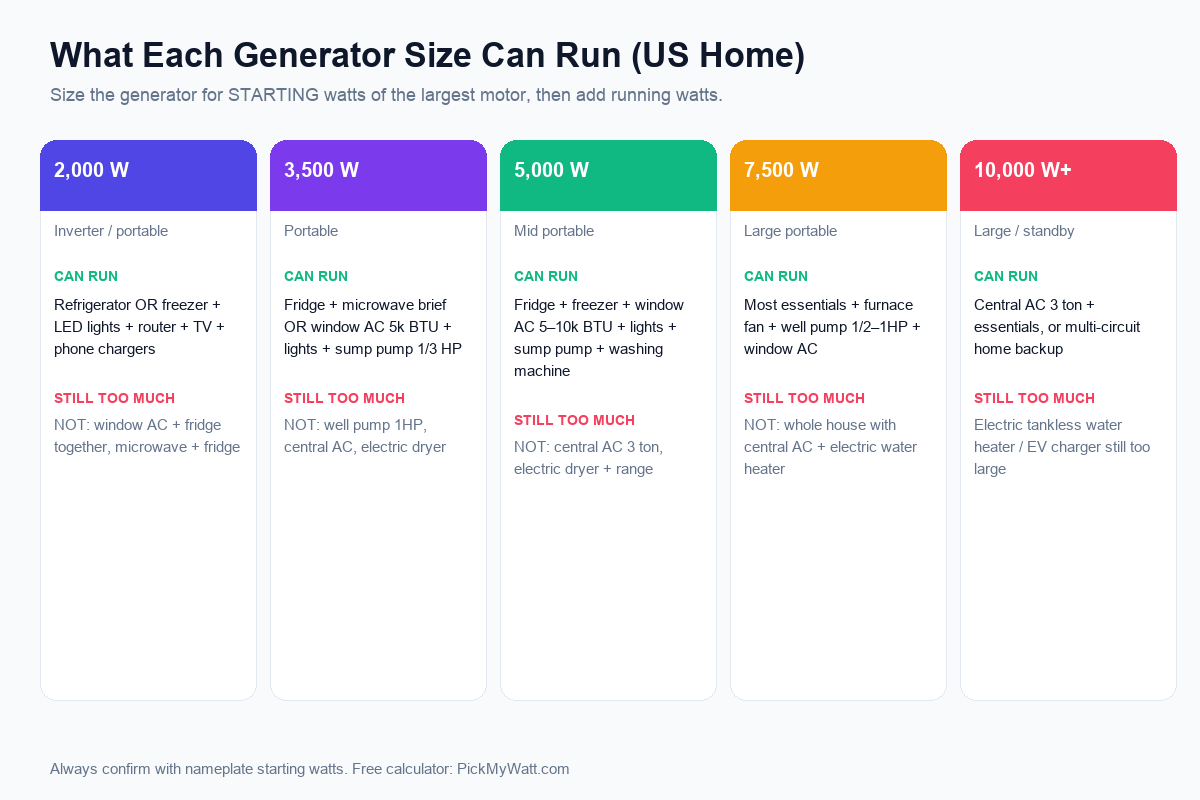
What size generator for a typical US house?
There is no single answer — it depends on which circuits you back up. These are planning buckets, not purchase orders:
| Generator size (running) | Good for | Usually not enough for |
|---|---|---|
| ~2,000 W | Fridge or freezer + lights + router + TV + chargers | Window AC + fridge at the same time |
| ~3,500 W | Essentials + microwave or small window AC + sump pump | Central AC, electric dryer, 1 HP well pump |
| ~5,000 W | Fridge + freezer + window AC + laundry (no dryer) | Central AC 3 ton + electric water heater |
| ~7,500 W | Multi-room essentials + furnace blower + well pump | Whole house with electric range + dryer + AC |
| 10,000 W+ | Central AC (3 ton) + selected whole-home circuits | Electric tankless water heater, Level‑2 EV charger |
“What size generator do I need for my home? … Smaller homes may require a 10–18kW home standby generator, while larger homes with multiple air conditioning units or high electrical demand may need 22kW-28kW.”
— Generac
Portable generators in the 3,500–7,500 W range cover selected circuits, not the whole panel.
Three sample load lists
1. Storm basics (frozen food + basement dry)
Refrigerator (400 W run / 1,200 W start) + freezer (300 / 1,000) + sump pump 1/2 HP (1,050 / 2,150) + LED lights (100) + router (20) → plan for ~2,150 W surge, ~1,870 W running. A solid 3,500 W class machine fits with margin.
2. Add a bedroom window AC
Basics above + window AC 5,000 BTU (600 / 1,200) → biggest surge is still the sump pump or fridge compressor depending on sequence. 3,500–5,000 W.
3. Rural well + winter heat
Well pump 1 HP (2,000 / 4,000) + furnace fan (800 / 1,600) + fridge (400 / 1,200) + lights/router → ~4,000 W surge on the well pump alone. 7,500 W+ or a standby unit is realistic.
How to turn this chart into a purchase decision
- List only what must run during an outage (fridge, freezer, well/sump, heat blower, lights, medical).
- Look up running and starting watts in the tables above (or on the nameplate).
- Add all running watts.
- Find the largest starting watt and add it to the running total (simple method). For a more precise NEC-style calc (continuous 125%, diversity), use the calculator.
- Apply the 80% rule if anything runs 3+ hours (NEC continuous load).
- Pick a generator whose continuous rating covers that number — not just the flashy peak number on the box.
Need the reverse — already own a machine? Use What Can My Generator Run?.
FAQ
Do starting watts really matter that much?
Yes. A 3-ton central AC can need 5,000–6,000 W to start even though it only runs at 3,000–3,500 W. Undersize the surge and the breaker trips every time the compressor starts.
Why do sources give ranges instead of one number?
Brand, age, efficiency tier (Energy Star vs older), and size (BTU / HP / ton) all move the needle. Ranges from manufacturer charts (Champion, Honda US) are for planning; your nameplate is the contract.
Is a bigger generator always safer?
Only if you also size fuel, cord/transfer switch, and noise. An oversized generator wastes fuel at light load; an undersized one browns out motors. Right-size, then add ~20% headroom.
Portable, inverter, or standby?
- Inverter: clean power for electronics, quieter, 2,000–4,000 W class.
- Portable conventional: more watts per dollar, louder.
- Standby (Generac-style): automatic, whole-home, 10–28 kW, needs install + gas/LP.
Where do I find my appliance's real wattage?
Nameplate on the back/bottom (usually listed as amps or watts), the owner's manual, or the yellow EnergyGuide sticker. For motors, look for LRA (locked rotor amps) or surge / peak watts.
Sources
- Champion Power Equipment — Generator Wattage Chart — US running & starting watt ranges for home, job-site, and RV loads
- Honda Power Equipment — Generator Wattage Calculator — US model estimates; “all wattages are estimates”
- Generac — Home Standby Generators — home sizing guidance (10–18 kW / 22–28 kW class)
- NFPA 70 (National Electrical Code) — Article 100 continuous-load definition; 210.20(A) continuous-circuit rule
Figures are estimates for US residential equipment and will vary by model, age, altitude, and temperature. Always verify nameplate data before purchasing or connecting a generator.